Müller-Lyer Illusion Explained: Which Line Is Longer?

A Classic Visual Trick That Makes Equal Lines Look Unequal
Do not reach for a ruler yet. Look at the two horizontal lines and decide which one appears longer.

Which horizontal line looks longer? Make your choice before reading the answer.
What did your eyes tell you?
Most viewers say that the line with fins spreading outwards looks longer than the line enclosed by inward-pointing arrowheads. It is a convincing impression-but the two horizontal shafts are exactly the same length.
This is the Müller-Lyer Illusion, introduced by the German sociologist Franz Carl Müller-Lyer in 1889. More than a century later, it remains one of psychology’s best-known demonstrations that surrounding context can change how a simple measurement appears.
Müller-Lyer Illusion explained: the fins change the judgement
The only meaningful difference is the direction of the short diagonal fins. When they open away from the shaft, the whole figure spreads across more space. When they point towards the shaft, the figure feels contained. The visual system does not judge the central line in perfect isolation; information from the complete pattern influences the estimate.
That is why knowing the answer does not completely remove the effect. You can understand that the shafts are equal and still experience one as longer. Measurement and appearance have parted company.
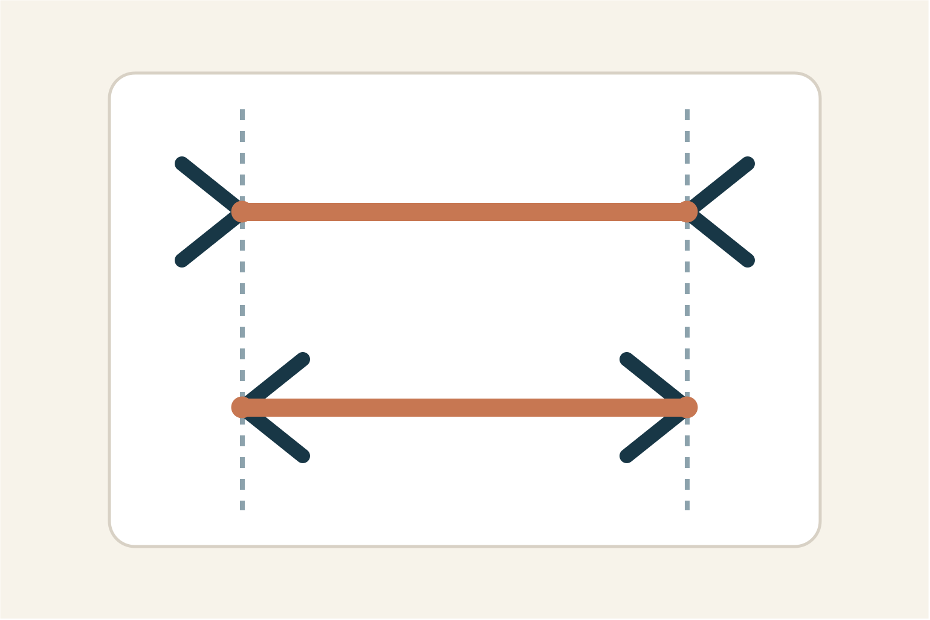
The dotted guides reveal the trick: both shafts start and finish at exactly the same points.
Why does the illusion happen?
There is no single explanation accepted as complete. Several processes probably contribute:
Context and averaging. The brain’s estimate of the shaft is pulled towards the total spread of the figure, including its fins.
Perspective cues. The fins resemble inside and outside corners. A visual system accustomed to interpreting three-dimensional scenes may apply depth-related size scaling to a flat drawing.
Low-level visual processing. Orientation, position and spatial filtering in the visual system can shift the represented endpoints of the lines.
Natural-scene statistics. Images with these patterns may usually come from physical sources of different sizes, so the percept reflects a normally useful probabilistic strategy.
The safest conclusion is not that the brain makes one particular mistake. It is that length perception combines the target with its surrounding structure.

Corner-like surroundings can make equal lengths feel different-an everyday echo of the illusion.
Try three quick variations
Cover the fins. Hide every diagonal mark with your fingers or pieces of paper. The equal shafts become much easier to recognise.
Rotate the page. Turn the image vertically or upside down. The illusion usually survives because the relationships among the lines remain.
Mark the endpoints. Add two vertical guides through the ends of both shafts. The guides provide a competing cue and expose their equality.
Does culture matter?
Classic cross-cultural studies reported substantial differences in susceptibility and proposed that people living in highly rectangular, “carpentered” environments might experience the illusion more strongly. Those findings became famous-but the story is less settled than many textbooks suggest.
A major 2025 reassessment argues that limitations in the historic evidence do not justify simple claims that the illusion is merely a Western cultural product. Experience, development and testing conditions may influence its strength, but researchers should avoid turning one visual display into a crude measure of culture or intelligence.
Why it matters
The Müller-Lyer Illusion shows that seeing length is not the same as reading a ruler. The brain usually makes fast, useful judgements from incomplete and contextual information. Carefully designed illusions reveal those rules by placing them in unusual situations.
It also offers a practical reminder: when precision matters-construction, medicine, research or design-measurement should outrank visual confidence.
The takeaway
Two equal lines can look unequal because the fins around them alter the way the entire pattern is organised. Your eyes are not broken; they are using context. The ruler simply has the final word.
Evidence and further reading
Müller-Lyer (1889). Optische Urteilstäuschungen The original description of the illusion in Archiv für Physiologie.
Howe and Purves (2005). The Müller-Lyer illusion explained by the statistics of image-source relationships A natural-scene statistical account published in PNAS.
Segall, Campbell and Herskovits (1963). Cultural differences in the perception of geometric illusions The influential early cross-cultural report.
Amir and Firestone (2025). Is visual perception WEIRD? A modern reassessment of claims about culture and the Müller-Lyer illusion.
Educational note:
This illusion is for education and entertainment. A person’s response cannot assess intelligence, personality, cultural sophistication or neurological health.


Comments