When the Hero Has No One
- Mymind Elevation
- 11 hours ago
- 7 min read

Loneliness, Identity and the Cost of Self-Sacrifice in Spider-Man: Brand New Day
The film’s most dangerous question is not whether Peter Parker can save the city. It is whether a person can remain whole when being useful becomes the only identity left.

A public role can become a refuge from the private pain of being unknown.
Spoiler guide The opening sections discuss the film’s premise and themes without revealing major resolutions. A clearly marked section later in the article contains significant plot spoilers. |
A world saved by someone it no longer knows
Spider-Man: Brand New Day begins with a brutal contradiction. Peter Parker remains responsible for everyone, yet belongs to no one. Four years after the memory spell at the end of No Way Home, he lives alone in a world that remembers Spider-Man but not the person beneath the mask. His old friends continue with their lives while Peter converts loss into work.
This is an unusually psychological superhero premise. The mask no longer merely protects Peter’s identity; it threatens to replace it. Fighting crime offers structure, moral clarity and immediate proof of usefulness. Private life offers grief, ambiguity and the risk of being rejected by people who cannot remember what they once shared.
The film therefore asks a question far beyond fantasy: what happens when competence becomes a defence against loneliness?
Loneliness is not simply being alone
Social isolation describes an objective shortage of relationships or contact. Loneliness is subjective: the painful gap between the connection a person has and the connection they need. Someone can be alone without feeling lonely, or surrounded by people while feeling completely unseen.
Peter’s isolation is both structural and emotional. He lacks ordinary companionship, but the deeper injury is discontinuity. The people who once knew his humour, fear, history and face no longer hold that shared story. The city celebrates an emblem; nobody recognises the young man carrying it home.
This matters beyond the cinema. The World Health Organization now treats social connection as a major public-health concern and reports that loneliness is especially common among adolescents and young adults. Connection is not a decorative extra after the “real work” is finished. It is one of the conditions that helps human beings regulate stress, maintain identity and recover from adversity.
The film’s central insight Being needed is not the same as being known. Admiration cannot substitute for intimacy, and usefulness cannot fully answer loneliness. |
When helping becomes an anaesthetic
Peter’s commitment to protect others is morally admirable. Yet the same behaviour can perform more than one psychological function. It can express values and also prevent contact with grief. Each emergency narrows the world to a task: identify danger, act, save, move to the next call. There is little time left to feel what has been lost.
Psychology does not require us to choose between “true heroism” and “avoidance.” Human motives are layered. Work, caregiving, activism and service can all be meaningful while also shielding a person from helplessness, memory or unmet need.
The warning sign is not dedication itself. It is role engulfment: the public function occupies so much psychological space that the private self has no room to rest, receive care, make mistakes or exist without performing.

The conflict is not between courage and weakness, but between a role and the whole person carrying it.
The mask as protection-and prison
Secret identities are a superhero convention, but concealment carries a recognisable cost. Privacy can protect safety and autonomy. Secrecy can also prevent the reciprocal vulnerability through which closeness develops. If nobody can know the truth, nobody can fully respond to it.
Peter’s mask permits him to be seen without being known. Citizens can thank Spider-Man, fear him or depend on him, but their reactions cannot reassure Peter that he himself is lovable. Praise attaches to the role. Pain remains with the person.
The film wisely avoids a simplistic message that every secret must be disclosed. In real life, concealment may protect people from stigma, discrimination or danger. The psychological question is whether a person has any safe setting in which the divided parts of life can meet.
Responsibility without limits becomes self-erasure
The Spider-Man ethic is built around responsibility. Brand New Day exposes its shadow: responsibility can expand until every preventable harm feels personally owned. The hero begins to live as if resting is negligence, receiving help is dangerous and private happiness must be earned only after the world is safe-which means never.
This resembles inflated responsibility, a pattern seen across anxiety, obsessive-compulsive difficulties, caregiving and trauma-related guilt. The person overestimates their duty to prevent harm and underestimates the legitimacy of limits, uncertainty and shared responsibility.
The correction is not selfishness. Mature responsibility asks three questions:
What is genuinely mine to do?
What belongs to another person, a team or a wider system?
What cannot be controlled, even by someone acting bravely and well?
A hero who cannot answer those questions may save others while progressively disappearing from his own life.
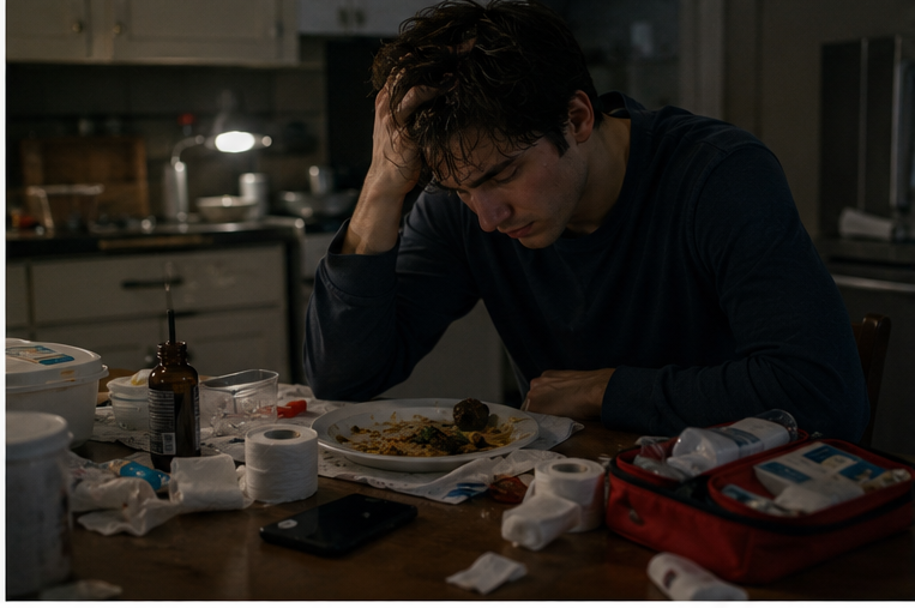
Self-sacrifice becomes dangerous when recovery is treated as a betrayal of duty.
The body eventually enters the story
The film externalises emotional strain through Peter’s changing powers and heightened reactivity. That is fantasy, not a clinical depiction, but the metaphor is strong: unprocessed stress does not remain politely separate from the body. Sleep, concentration, pain, irritability, appetite and threat sensitivity can all change under sustained strain.
What the film should not encourage is retrospective diagnosis. Peter is a fictional character living under magical and superhuman conditions. His loneliness, anger or self-neglect cannot establish depression, post-traumatic stress disorder or any other diagnosis. A real assessment would require duration, impairment, wider symptoms, context and alternative explanations.
Clinical boundary A psychologically rich film can illuminate experiences without turning a character into a case report. Interpretation is useful; armchair diagnosis is not. |
Why the Punisher matters
The contrast between Spider-Man and the Punisher places two responses to pain beside one another. One tries to preserve life even when doing so is difficult; the other accepts violence as a route to control and justice. Both identities are organised around harm, but they make different moral claims about what suffering permits a person to become.
Peter’s refusal to surrender compassion is not naïveté. It protects his moral identity. Trauma does not automatically make people violent, and anger is not equivalent to danger. The psychologically important question is how grief, rage and power are integrated with values, accountability and relationship.
MAJOR SPOILERS FROM THIS POINT
The following discussion reveals important developments involving Peter, MJ, Ned and the film’s resolution.
Memory is not consent
Peter’s attempt to reconnect with MJ contains the film’s most mature relational idea: shared history cannot be used to demand present intimacy. Peter remembers a profound bond. MJ does not experience that bond from the inside. Learning what happened may explain his grief, but it does not obligate her to reproduce feelings she cannot access.
This distinction is psychologically and ethically important. Love is not ownership of another person’s future because of a previous relationship. Memory gives Peter a claim to his own sorrow, not a claim over MJ’s choice.
Her response forces him to confront a painful truth: restoration may not mean recovering the exact life that was lost. Grief sometimes ends not with reversal but with a new relationship to reality.
Recognition begins in the body
Ned’s partial recognition through their familiar handshake offers a different image of relational memory. Longstanding relationships are encoded not only as explicit facts but also through habits, rhythms, expectations and embodied familiarity. The scene is magical within the story, but emotionally persuasive: being known often resides in small patterns that are difficult to summarise.
Crucially, reconnection does not solve every problem. It opens a door. Peter must still risk being present as a person rather than retreating entirely into usefulness.
The real “brand new day”
A new day is not a clean psychological reset. Peter does not become untouched by loss. The more credible transformation is integration: Spider-Man remains part of him, but need not consume Peter Parker. Responsibility remains a value, but can coexist with friendship, grief and dependence.
That is the film’s deepest argument. Resilience is not solitary invulnerability. It is the capacity to continue while allowing experience, relationship and identity to change us.
What the film gets right
● Loneliness can hide behind extraordinary productivity and public usefulness.
● A role can protect identity while gradually replacing it.
● Self-sacrifice is not automatically healthy simply because its goal is noble.
● Grief cannot always be repaired by restoring the past.
● Connection requires mutual recognition, choice and vulnerability.
● Receiving support is compatible with responsibility-not evidence of its failure.
What the film simplifies
Cinema compresses recovery into encounters, revelations and decisive action. Real loneliness is often less visible and less dramatic. Rebuilding connection may involve repeated contact, uncomfortable honesty, community participation, practical support and treatment for depression, anxiety or trauma where present.
The film also individualises a problem with social dimensions. Connection depends on affordable spaces, safe communities, time, transport, inclusion and cultures that allow people-especially young men-to express need without humiliation. Telling an isolated person simply to “reach out” is incomplete if no responsive network is available.
A reflection for the person behind the role
The film leaves viewers with useful questions:
Who knows me when I am not performing my most competent role?
Do I offer help because it expresses my values, or because stillness exposes pain?
What needs have I labelled selfish because other people depend on me?
Which responsibilities are truly mine-and which have I absorbed?
What small act of honest connection would allow someone to meet the person behind the mask?
These questions are relevant to doctors, carers, parents, leaders and anyone praised for always being strong. The mask may look different, but the bargain is familiar: remain useful and perhaps nobody will notice how alone you are.
The Spotlight takeaway Spider-Man: Brand New Day understands that heroism without relationship becomes a form of disappearance. Peter does not need less responsibility; he needs a life large enough to contain responsibility without sacrificing the person responsible. |
References and further reading
Marvel Studios. (2026). Spider-Man: Brand New Day-official film page and synopsis. Marvel
World Health Organization. (2025). From loneliness to social connection: charting a path to healthier societies. WHO report
Hawkley, L. C., & Cacioppo, J. T. (2010). Loneliness matters: a theoretical and empirical review of consequences and mechanisms. Annals of Behavioral Medicine, 40, 218–227. Full text
Matthews, T. et al. (2016). Social isolation, loneliness and depression in young adulthood: a behavioural genetic analysis. Social Psychiatry and Psychiatric Epidemiology, 51, 339–348. Full text
Swann, W. B. Jr. et al. (2014). What makes a group worth dying for? Identity fusion fosters perception of familial ties, promoting self-sacrifice. Journal of Personality and Social Psychology, 106(6), 912–926. PubMed
Editorial note:
This essay analyses themes in a fictional film. It does not diagnose its characters or suggest that superhero experiences represent clinical conditions. The accompanying images are original editorial illustrations, not film stills.


Comments